

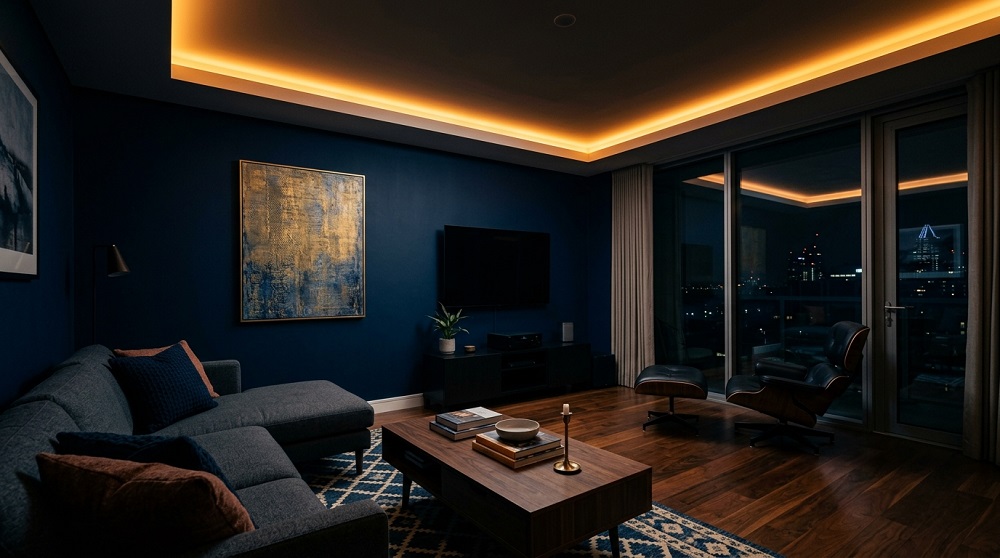
Lighting is the cheapest way to transform a room and the most commonly ignored. Most homes still run on the same arrangement builders installed decades ago: one fitting in the middle of the ceiling, one switch by the door, one setting — on.
That single light source is responsible for more flat, unflattering rooms than any paint colour ever has.
Table of Contents
Think in Three Layers
Good lighting isn’t one bright source. It’s three types working together.
Ambient Light
The general illumination that lets you move around safely. Ceiling fittings, downlights, wall washers. It should be even, comfortable and — importantly — dimmable.
Task Light
Directed light where you actually do things: reading chairs, kitchen worktops, desks, bathroom mirrors, bedside tables. Task lighting fails when the source is behind you and your own shadow lands on the work.
Accent Light
The layer that creates atmosphere. Picture lights, shelf lighting, uplighters, lamps that pool light into corners. It contributes little to brightness and almost everything to how a room feels.
Most homes have the first layer and nothing else. Adding the other two is usually a matter of lamps and sockets, not rewiring.
Get the Colour Temperature Right
Measured in kelvin, this is the difference between a room that feels welcoming and one that feels like a waiting area.
- 2200–2700K — warm, relaxing; bedrooms, living rooms, dining spaces
- 3000K — warm-neutral; kitchens, bathrooms, hallways
- 4000K+ — cool and clinical; garages, workshops, utility spaces only
Keep temperatures consistent within a room. Mixed bulbs are a common and surprisingly noticeable mistake — one warm and one cool fitting makes both look wrong.
Room-by-Room Ideas That Work
Kitchen
Under-cabinet lighting is the highest-impact upgrade in the house. Ceiling lights put your shadow directly onto the chopping board; under-cabinet strips remove it entirely. Add pendants over an island for a second layer.
Living Room
Aim for four or five light sources rather than one. Table lamps, a floor lamp beside seating, something low near the corners. Put as much as possible on dimmers.
Bedroom
Bedside lights that can be controlled from the bed, warm bulbs, and nothing bright overhead in the evening. Wall-mounted reading lights free up nightstand space.
Bathroom
Light the mirror from both sides at face height rather than from above. Overhead-only lighting casts shadows exactly where you need to see.
Hallways and Stairs
Often overlit and unwelcoming. Wall lights at lower levels feel far better than a bare ceiling fitting, and low-level night lighting is genuinely useful.
Small Changes With Large Effects
- Fit dimmers everywhere — the single best value lighting upgrade available
- Add more sockets so lamps can go where they’re useful, not where wiring allows
- Use lamps in corners to give a room depth instead of flat central brightness
- Bounce light off ceilings with uplighters for soft, shadow-free ambient light
- Check bulb output in lumens, not watts — LEDs make the old wattage habit meaningless
Layer, Warm, Dim
If you remember three things: build in layers, keep the colour warm, and make everything dimmable.
Almost every well-lit home follows those rules, and almost every badly lit one breaks all three.