

Outdoor spaces get renovated in the wrong order more often than any other part of a home. People buy plants before fixing drainage, lay decking before checking sun paths, and install lighting before deciding where anyone will actually sit.
A garden is a construction project with living components. Treat the structure first and the planting becomes easy.
Table of Contents
Fix the Ground Before Anything Else
Drainage
Standing water kills plants, rots timber, undermines paving and makes a lawn unusable for months. If your garden holds water after rain, solve that before spending on anything decorative. Improved soil, a soakaway, or regrading a slope will do more than any feature you could buy.
Soil
Most disappointing planting is a soil problem. Compacted, thin or exhausted soil produces struggling plants regardless of what you spend on them. Adding organic matter over a couple of seasons quietly transforms results.
Design Around How You’ll Use It
Spend a week watching your own garden before you change it. Where does the sun fall at 6pm? Which corner is sheltered from wind? Where does everyone naturally walk?
Most gardens need three zones:
- A place to sit — positioned for evening sun, not midday
- A route through — paths that follow the desert lines people already walk
- A working area — bins, storage, compost, tools, screened but accessible
Design the seating spot first. Everything else arranges itself around it.
Improvements Worth the Money
Hard Landscaping That Lasts
A well-built patio, path or retaining wall will outlive several rounds of planting. Pay for correct sub-base preparation — nearly all paving failures are foundation failures, not surface ones.
Boundaries and Screening
Fences, hedges and pergolas define space and create privacy faster than anything else. A hedge is slower but cheaper long-term and far better for wildlife.
Outdoor Lighting
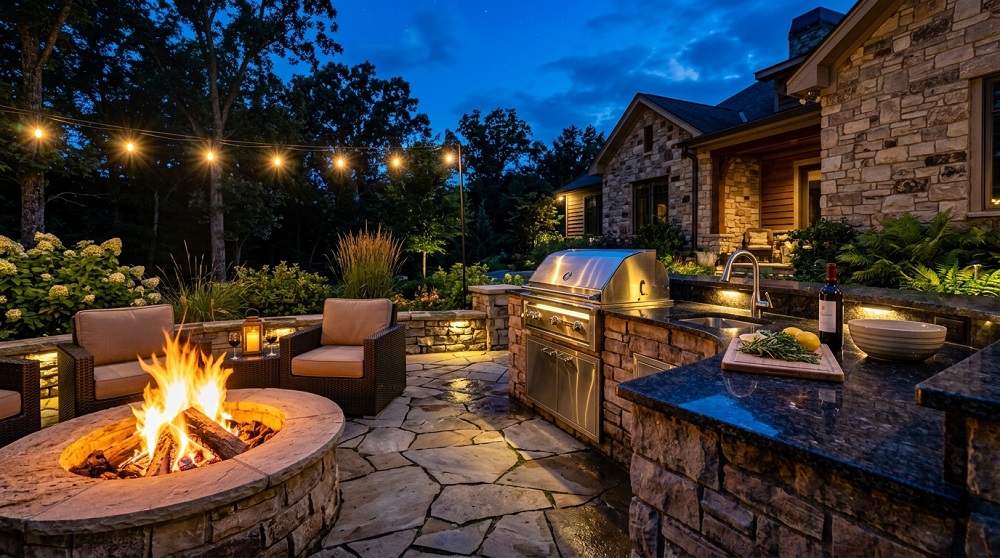
Low-level path lights and a few uplighters into trees extend the usable hours of a garden enormously. Keep it warm-toned and sparse — over-lit gardens look like car parks.
Water Access
An outside tap and a water butt make everything else easier to maintain. Unglamorous, cheap, and the thing people wish they’d installed first.
Plant for Your Conditions, Not the Catalogue
Match plants to your actual light, soil and rainfall and they’ll largely look after themselves. Fight those conditions and you’ll be watering, feeding and replacing indefinitely.
A reliable structure:
- Evergreen backbone — 30% of planting, gives winter shape
- Shrubs for bulk and seasonal interest
- Perennials for colour that returns each year
- Bulbs for early spring, planted in autumn
- A tree if space allows — the single highest-impact planting decision
Plant in odd-numbered groups. Repeat the same species across the space to make it feel deliberate rather than collected.
Reduce Future Work
Every improvement carries a maintenance cost. Deep mulch suppresses weeds and holds moisture. Generous bed edges stop grass creeping in. Drip irrigation on a timer removes the daily watering job. Smaller lawns mean less mowing.
Building maintenance reduction into the design is what separates a garden you enjoy from one you resent.
Work in Stages
Few people can do everything at once, and that’s an advantage. Fix drainage and boundaries first, then hard surfaces, then planting, then lighting and detail.
Each stage makes the next one easier — and you’ll understand the space far better by the time you’re choosing plants.